A Game Written for Human Eyes
Croatia lost to a touch no human could see. Norway lost to a silence no human can verify. Iran lost to a margin no human could feel.
In the 102nd minute of Portugal vs. Croatia, Croatia seconds from elimination, Joško Gvardiol slid the ball into the net, cinched the equalizer. The Croatian fans rose up from the bench and rejoiced. The Croatian bench sprinted to the field to celebrate the heroic goal. Luka Modrić’s last World Cup is going to extra time.
Then, the whistle blew. VAR review ensued. A waveform appeared on the screen. A flat line with a small spike, aligned with the replay of the moment the ball floated past Igor Matanović’s head. The sensor inside the ball had registered a touch off of his head, or what appears in high resolution broadcast, possibly off of his hair. The touch meant Mario Pašalić was offside in the buildup leading up to the goal. The lead ref turned around from the monitor, walked onto the field, drew the rectangle in the air, and Croatia’s miracle equalizer was cancelled. Before the announcement even finished, the camera found Modrić walking away with a bitter smile, throwing his hands in the air in exasperation. Croatia was out of the World Cup because of a data spike.
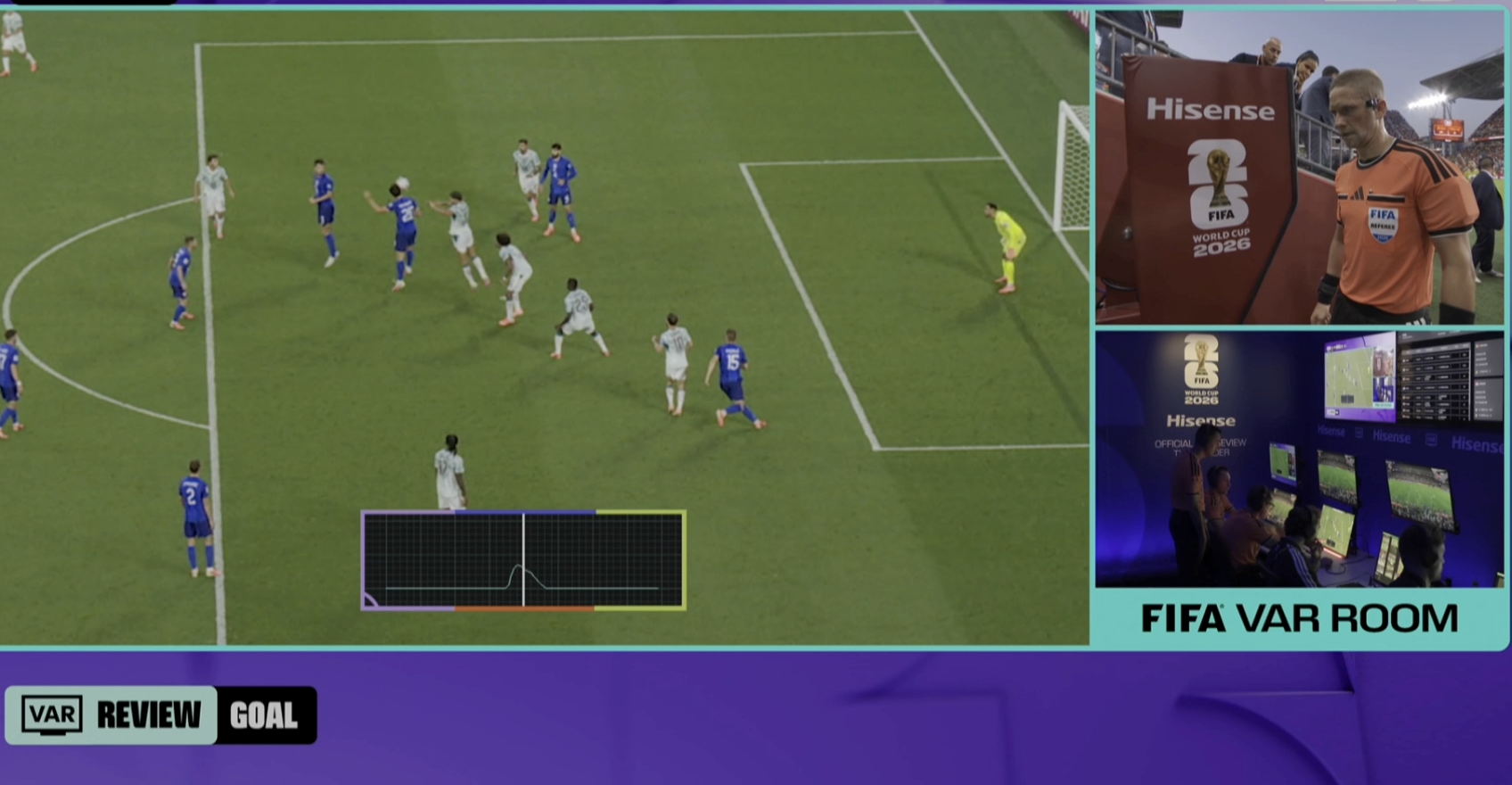
The Croatia–Portugal review, with the sensor waveform beneath the replay. Broadcast screenshot via Sports.ru; FIFA Media’s explanation.
Croatia’s manager Zlatko Dalić said in the post-match conference that “VAR kills emotions, it kills everything within you”. Portugal’s manager Roberto Martínez shrugged “it’s not a subjective opinion.” “The ball has a chip.”
As a Cristiano Ronaldo fan myself, as much as I would love to see Portugal advance, this felt wrong. And the unsatisfying conclusion I came down to was that both of the coaches are right. The call was correct based on the presented evidence. But it doesn’t take away from the feeling that Croatia was robbed.
Isn’t technology supposed to make referee calls more accurate, less biased, and more evidence based, thereby reducing controversies? I watched nearly every game in this series and can confidently say technology did not eliminate the controversy. Technology has migrated the controversy from “did the referee make the right call?”, to whether the Laws of the Game, the institution, and the evidence should work this way at all.
What happened to Croatia presents one kind of problem: the sensors detected something humans couldn’t see.
Norway vs. England game presented the inverse (possibly).
In the quarterfinal around halftime, Norwegian goalkeeper Ørjan Nyland’s goal kick appeared to have clipped the Spidercam wire above the pitch, lofted high in the air before dropping sharply back into play. England’s Elliot Anderson took control of the ball, passed to Anthony Gordon, who found the charging Jude Bellingham with a brilliant long pass, and Bellingham scored. Nyland pounded the grass with his gloves. England went on to win 2-1, carrying the half-time equalizer momentum.
What the broadcast briefly showed after the goal was the Norwegian goalkeeper talking to the referee and pointing to the sky. The rule here is very clear: if the ball touches anything other than a player or the field, the play has to stop and restart. Much of this discussion wasn’t made clear or public during the live broadcast of the game, but discussions happened after the match where upon investigation, FIFA declared the ball’s heartbeat didn’t show a peak, which meant there was no evidence the ball had contact before it dropped down to Anderson, and England’s goal stood.
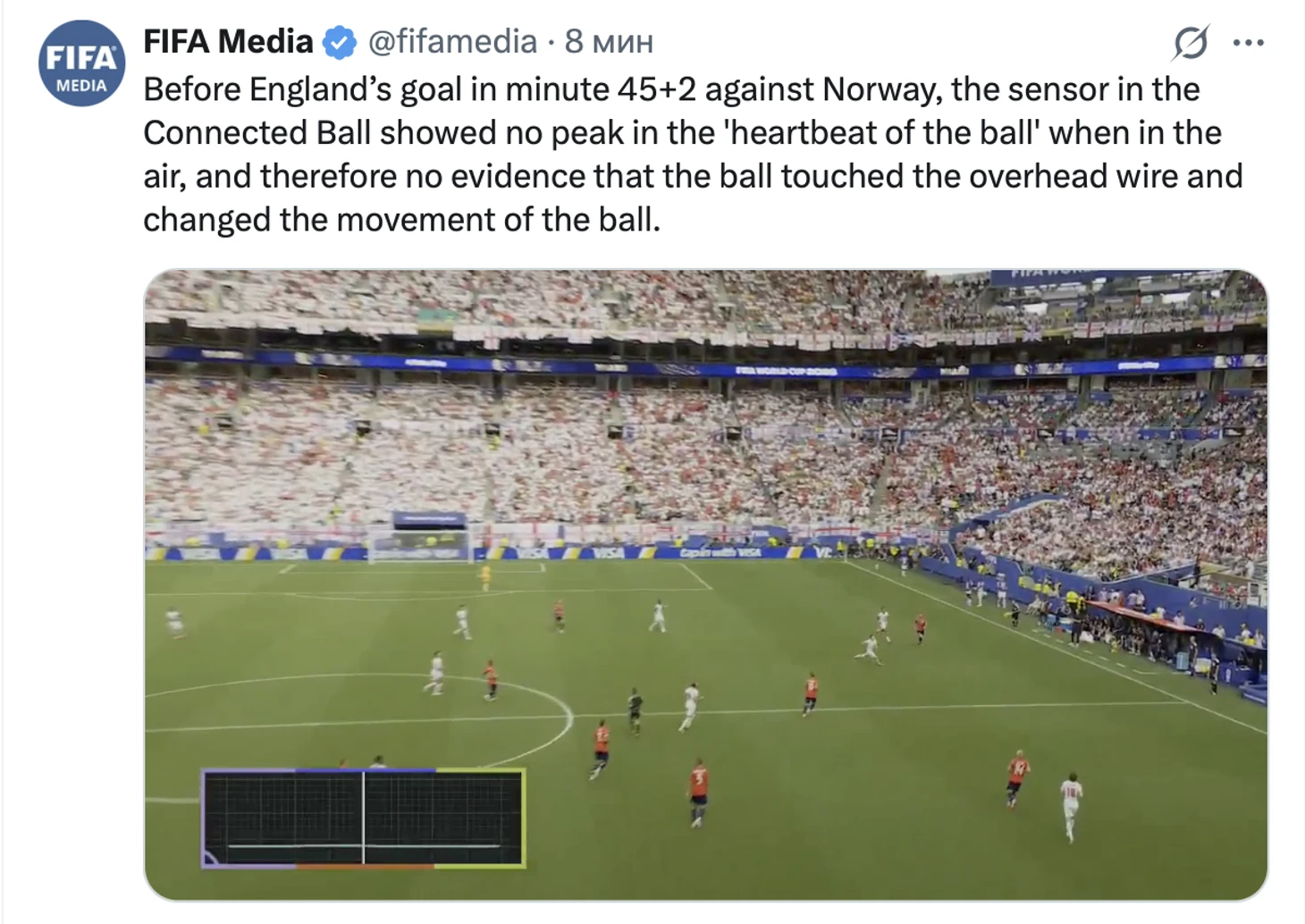
FIFA Media’s published explanation of the Norway–England incident. Screenshot via Sports.ru; original FIFA Media post and video.
Norway’s coach Ståle Solbakken sounded defeated saying in the post-match interview: if the chip says there was no sound, what can you say against that? Indeed, the blurry and far away camera footage and Norwegian eye witnesses where the ball had changed directions sharply weren’t enough evidence to counter the lack of signal produced by the sensor in the football.
Putting these two cases side by side. Against Croatia, the sensor overruled human perception to take a goal away. Against Norway, the sensor overruled human perception to let a goal stand. In both cases, the sensor was the definitive evidence that won.
This may look like a consistency, but from a signal processing perspective, the two claims are not the same. In Croatia’s case, detecting a touch is a positive finding. In Norway’s case, no peak in the heartbeat is a negative finding. Negative findings carry the extra burden of proof that the signal wasn’t lost. So no signal above some detection threshold in a processed data stream doesn’t necessarily mean no contact occurred.
If we look at the waveform published by FIFA, we have a large spike from the goal kick, followed by practically a flatline, even though we know for sure the ball is moving through the air. The waveform has no labeled axes. We can infer the x-axis is time, but that’s it. All we know is whatever the line represents, it has been transformed from raw sensor data, likely a combination of gyroscope, accelerometer, and pressure sensor within the ball. At every data transformation step, someone has made a choice on which signal matters, which frequencies are noise, what counts as a meaningful signal, and what threshold distinguishes contact from everything else that happens to a ball in flight. The final system can be extremely sensitive to the event it was designed to detect (e.g: human touch), and much less sensitive to events outside of the distribution (e.g: ball grazes spidercam wire). So the same pipeline that’s capable of catching a light human touch can plausibly miss a ball grazing a taut cable in midair, if the system wasn’t designed to detect the ball grazing the cable.
Iran vs Egypt, group finale, third minute of stoppage time, Shoja Khalilzadeh bundles the ball home. Rejoice among Iranian fans at the prospect of Iran reaching the knockout stage for the first time in history.
Then the offside graphic appeared. It showed the front of Khalilzadeh’s boot, just the tip, beyond the line. A commentator said that if his foot were one shoe size smaller, he might not have been offside. That sentence stung. What a heartbreak for Iran.
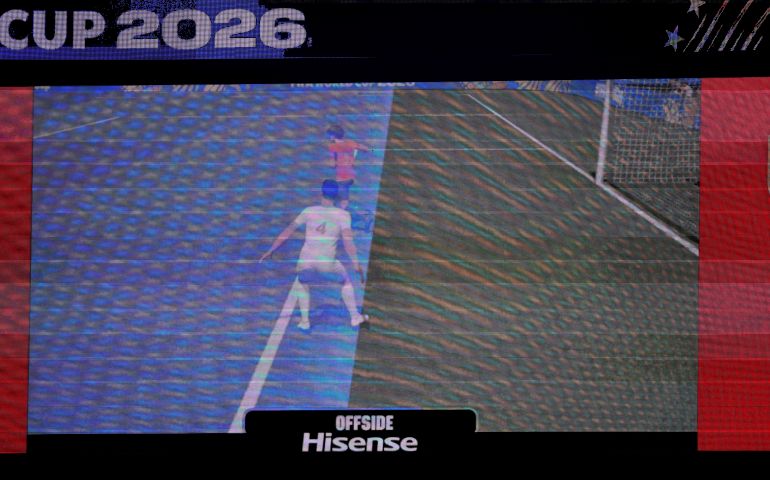
The offside graphic shown in the stadium during Iran–Egypt. Photo: Richard Heathcote / Getty Images / AFP, via Al Jazeera.
In this scenario, the measurement did what it is supposed to do. Iran’s coach Amir Ghalenoei said it plainly: "That's justice. But I'm upset by the bad luck." I can’t help but feel this is incredibly unfair. On a pitch that wide, during active play, competing at arguably the highest stake representing one’s nation during the World Cup, how can a player track offside to the centimeter precision? Historically the offside law always had human tolerance built in implicitly, since the linesmen’s eyes likely couldn’t resolve a boot tip and wouldn’t flag it. Today, the sensors removed the tolerance. If an infraction is undetectable to a highly trained human in real time, we should consider adapting the rule. Not necessarily by abandoning precision that technology affords us, but by closing the gap between what the system measures and what a player can perceive.
We can tackle this problem from two ends:
- Degrade the measurement to human scale. We can denominate offside in body parts instead of centimeters. A foot is offside, but 5cm part of a foot doesn’t have to be. A rule based on body part units is something that players can feel and fans can see; the ease of witnessing helps to make the rule more acceptable to lose to.
- Upgrade player perception to match machine scale. The tracking system already computes the offside line in real time. I have a wild proposal: project it. Give players a visible line on the field. The line can turn red when they have run offside or orange when they are close to being offside. Give players a chance to self-correct during the run. Currently this technology is always wielded post-hoc: the machine is the judge that arrives after the crime, after the celebration. A live line makes the machine part of the environment instead, like the sidelines themselves. Good games make rules visible and explicit and don’t penalize players retroactively.
Croatia lost to a touch no human could see. Norway lost to a silence no human can verify. Iran lost to a margin no human could feel. In all three moments, despite having different sensors and different outcomes, we have the same underlying structure: a system’s processed output became the final verdict, and the people living under the verdict couldn’t see, question, or act on it.
This is not a football structure. This is a loan officer reading a risk grade. This is a hiring manager reading a resume ranking. 2026 World Cup just ran this experiment in public, in front of billions of emotionally invested stakeholders. Every choice made by some engineers upstream of what threshold should count, what signal is noise, has now disappeared behind a squiggle, and “the ball has a chip and this is the fact” has become what ends the conversation.
The 2026 World Cup settled the measurement question: the machines can find the truth, down to a hair. What it opened is the harder question that’s not technical at all: should a game invented for human eyes rewrite its laws for a world that can measure the game better than anyone who can see it? I would like to see the rules be adapted to the following criteria:
- Legible: can the people governed by these rules perceive what it perceives?
- Transparent: can people see how the system reached its answer, including what it can’t detect? (Maybe we can start with actually labeling the axes)
- Actionable: can people respond while it still matters and not compromise the watchability of the game?
I'll be watching in 2030 either way. I'd just like to scream without hesitating first.